
Agentic AI Isn’t a Single Workload — It’s an End-to-End Workflow

Most AI infrastructure discussions begin with models running on GPUs. In practice, however, infrastructure demands are increasingly shaped by everything surrounding the model rather than the model itself.
Agentic AI systems don’t just respond to prompts. They interpret intent, retrieve context, plan steps, call tools, enforce policies, execute sandboxed code, run transactions, evaluate results, and iterate until completion.
Each step represents a different workload. Together, they form a complex workflow with varying compute needs. Some stages require high core density, others depend on high-frequency performance and low latency. Others are constrained by memory capacity, I/O throughput, data locality, energy efficiency, or the need to support many concurrent services.
As agentic AI scales, infrastructure planning can no longer rely on a single compute profile. CIOs and enterprise leaders need a diversified CPU strategy aligned with the full workflow.
The AMD EPYC™ server CPU portfolio is built for this reality—not as a one-size-fits-all solution, but as a range of processors optimized for different stages of agentic workloads.
Understanding the Agentic AI Workflow
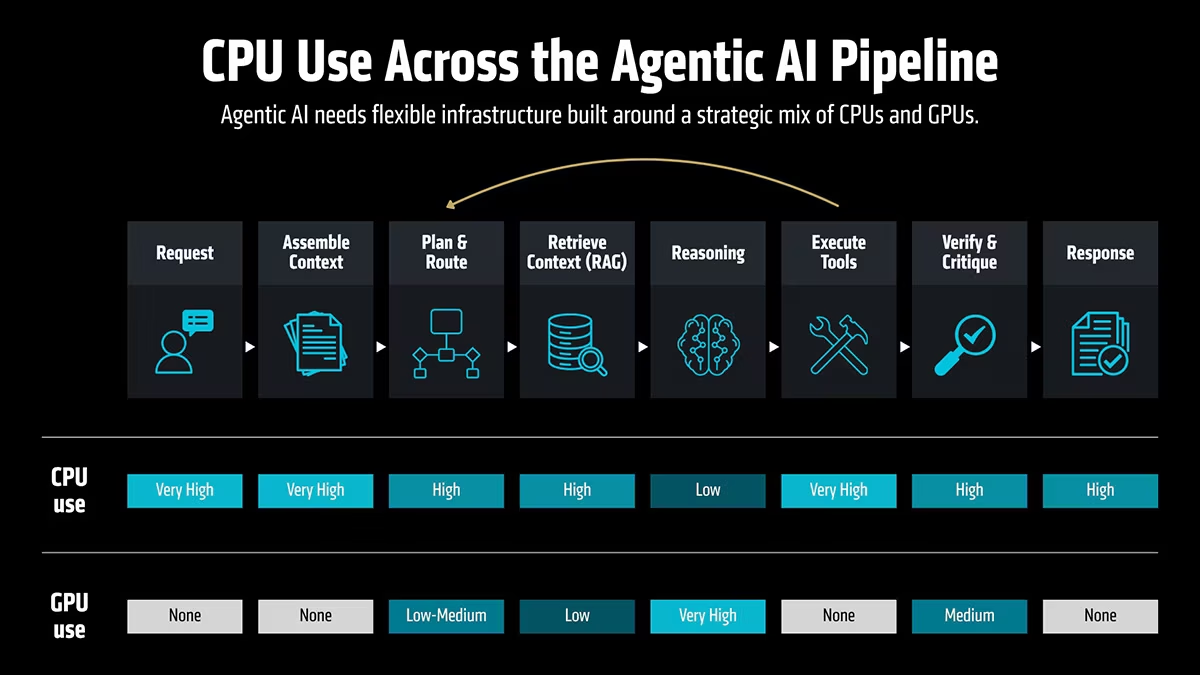
When an AI agent receives a task, it breaks it into steps and often iterates multiple times before completion.
A typical flow starts at a request gateway where policies are applied. A planning layer—often powered by smaller models—routes the task. The agent then queries databases, calls GPU-based inference services, executes tools, validates outputs, and decides whether to continue or finish.
This makes agentic AI a full workflow, not a single compute task. Effective infrastructure starts by mapping each stage and assigning the right compute resources.
AMD supports this end-to-end stack with EPYC™ CPUs for general-purpose and high-density compute, AMD Instinct™ accelerators for training and inference, and Pensando™ networking for predictable data movement.
Where Latency Matters, Where Throughput Wins
Each stage has different requirements, which is why AMD EPYC is designed across multiple performance profiles.
Orchestration, sandbox execution, tool calls:
When many agents run simultaneously—executing code, calling APIs, or querying databases—core density is key. 5th Gen AMD EPYC™ processors offer up to 192 cores and 384 threads, while the upcoming “Venice” generation scales up to 256 cores and 512 threads.
Enterprise tool execution:
Agents rely on deep integration with enterprise systems. CPUs that balance multi-core performance and throughput handle this workload best. The AMD EPYC™ 9005 series ranges from 8 to 192 cores and up to 640GB/s memory bandwidth, with “Venice” expected to further increase core count by 1.3x and bandwidth by 2.5x.
Inference and reasoning:
GPU inference workloads depend on CPU host nodes to stay fed with data. Here, high single-core performance, frequency, memory bandwidth, and I/O are critical. The AMD EPYC™ 9575F delivers this balance with 64 cores running up to 5GHz, with “Venice” extending high-frequency performance further.
The Legacy Infrastructure Gap
Two patterns stand out in enterprise environments.
First, many organizations still standardize on older CPU configurations such as 16- or 32-core systems. Agentic AI, however, requires more flexible infrastructure—some stages need high core counts, others need high frequency. The approach must shift from fixed standards to a workload-driven CPU portfolio.
Second, as agents multiply, they significantly increase demand across enterprise systems like databases, ERP, CRM, analytics platforms, identity services, and inference servers. IT teams need to prepare for this cascading load.
The Question for CIOs
Agentic AI is changing how infrastructure is sized. Treating it as a single workload—whether through one GPU strategy or a uniform CPU model—creates limitations.
A more effective approach is to design for the full agent lifecycle, where each stage maps to different compute needs. By aligning infrastructure early with these workflow stages, enterprises can scale more efficiently and cost-effectively.
The key question is no longer how many CPUs or GPUs are needed, but whether infrastructure is properly matched to how agentic AI actually operates across multiple stages and workloads.